-
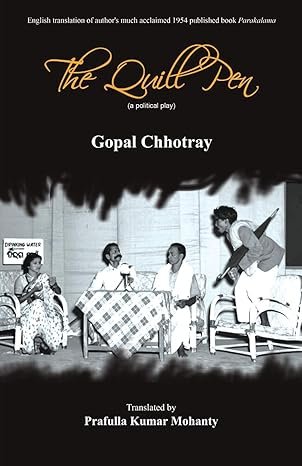
The Quill Pen
₹250.00Rural Odisha’s modernization and the birth pangs of a sound political structure resolving all ethical binaries is the primal theme of Gopal Chhotray’s Academy Award winning play Para Kalam(The Quill Pen). The realism of proscenium drama was given a technical facelift by the dramatist and can safely be called innovative and the introducer of post realist dramaturgy into the Odia stage. The Quill Pen being the first political play in Odia has several layers of meaning. The change in socio-intellectual awareness in rural Odisha apart, the fight for food security stymied by bureaucratic corruption tacitly supported by the political masters also has been dramatized with artistic fervor. The hero of the play is the Chief Minister of the state but is torn between his political aspirations and ethical compulsions. Finally the arc of the play bends towards moral energy and the Chief Minister rises above petty mundanity to sacrificial heroism. Love, although not the main thrust of the play has a fair measure of sophistication. The composition of scenes like the stringing of a pearl necklace is masterly. At the same time the dramatist’s understanding of the rural milieu, modern aspirations and his grasp of the economic and political realities of Odisha are a touch above the ordinary. Gopal Chhotray’s deep moral sense and his hope for the development of Odisha are discernible despite the impersonal dramatization of a very complex theme. The Quill Pen is majestic on stage and gripping on the study table.
-
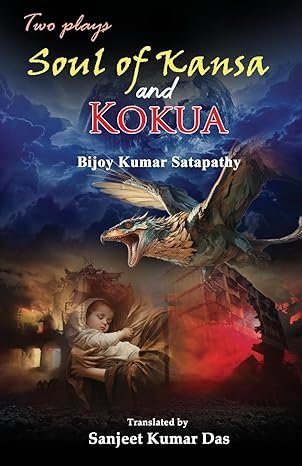
Two Plays: Soul of Kansa and Kokua
₹250.00The Soul of Kansa is of two Acts. Act I highlights the Indian myth, as prescribed in the Mahabharat, of the conflict of vice and virtue. The protagonist, Kansa, stands for evil. This protagonist was of the Dwapar Yuga (Three thousand years earlier was in this Indian peninsula). A tyrannical ruler Kansa oppressed the ordinary people greatly. Kansa is not with us physically; his soul is very much alive in the society. The character Andhak represents the soul of Kansa.
The second play, Kokua, revolves around Dhamaguda, a tribal village. Kokua is an imaginary, frightful, and mysterious character of the Mahabharata, one of the great epics of India. The Mahabharata of India has many regional versions in different languages. The Kokua anecdote is well described in Sarala Das’s Odia Mahabharata. Kokua comes down, when the degree of doubt, disbelief, terror, murder, and anarchy overpowers the world. Because of the industrial growth and development, the tribes lose their land, rivers, brooks, forests, and simple lifestyles. Their mind gets polluted. The tribes are deprived of their natural rights. The issues of these locals are very beautifully reproduced. Shyamananda is the owner of the Ashram wherein Atanu was a disciple and later becomes the Police Inspector. At the same time, Ajay Marandi was also a disciple and later becomes a Naxal leader or Area Commander. Shyamananda’s erstwhile belief was that he would guide rightly the students of this village to follow the path of non-violence. His dream is shattered in due course of time. Shibu (Also known as Sadashiba Rao) is a character supporting the Maoist movement. -
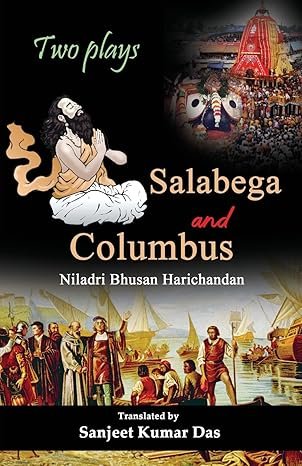
Two Plyas: Salabega and Columbus
₹250.00Columbus’s adventurous and romantic sea voyage and indomitable zeal to explore the ‘New Land’ or country is concatenated as a fresh chapter to the geographical history of the world. Though Columbus discovered America, it was named after the deceitful tartuffe Amerigo Vespucci. Along with the sufferings of the sea expedition and the apprehensions of life, he has subsequently experienced and overcome the frequent conspiracies plotted against him by his crew members on the ship and the royal court. Columbus marches ahead steadily with his strong mental prowess. He comes across failures time and again. But he has yet to deviate from his path to reach the goal. His only ambition is to discover the ‘New Land’. Struggling for a long time in the Atlantic Ocean, he continues his expedition despite the hiccoughs and huddles on his way. To him, life aims to carry on adventurous journeys on sea irresistibly and uncontrollably. The life of Columbus is flamboyant. More dramatic is his struggling life and exhilarative journey on the sea. The combating spirit, intense desire and apprehensions he encountered help him live life with unbeatable strength and are a humble endeavour made through this play Columbus.
In Odisha’s religious world, the non-Hindu poet Salabega has a strange personality. By birth, Salabega is a Muslim, but he is one of the supreme devotees of Lord Jagannath. All his hymns or devotional songs are dedicated to Lord Jagannath. He has not been confined to Islam religion. Though he was a devotee of Jagannath, he couldn’t be a Hindu throughout his life. He is prohibited from entering Jagannath Temple, Puri. Being trapped on the horns of the dilemma, he suffers a lot and plans for a new religion. Later, he named it the ‘Religion of Humanity’ and the natural outcome of that time. The play declares that, having been released from narrow parochialism and blind beliefs of caste and religion, Salabega has come forward irresistibly to propagate and establish his religion worldwide. To him, this ‘Religion of Humanity’ is true and eternal. He has consistently followed the path of righteousness. Wandering between two main religions, the mental strife or agonies he has undergone are the stuff for me in creating characters like Salabega. With a poetic sensibility and soul, this play has been scripted and published for the larger audience of the world.