Availability: In Stock

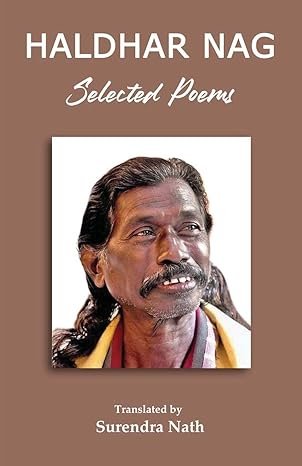
Selected Poems of Haldhar Nag

Author: Haldhar Nag

250.00

“I have often wondered if Haldhar Nag graduated from a poetry school. Of course, that cannot be true, but my feeling arises from the abundance of figures of speech that appear in his poetry. Unknown to him, he sprinkles liberally the effects of alliteration, metaphors, internal rhyming, personification, onomatopoeia, and what have you in his usage. Ghensali (River Ghensali) is personification at its best, where the poet personifies a river in spate as a young lass in exuberance. And yes, he has come out with sonnets too. Read Ati (Too Much) to get a taste of Haldhar sonnet. The stanzas are spaced in 4, 4, 4, 2 lines, with a proper rhyme scheme. It leaves me in wonderment again – If he did not go to a poetry school, then did God plant all these literary usages in his head?

For the sound effect, listen to Chaetar Sakaal (The Morning of March) – twelve stanzas replete with

onomatopoeic works. Pity the translator who has to preserve the special effect in another language. I take recourse to the limitations of translation once again and state the obvious: Translations can never attain the beauty of the original. If we liken the original to an attractive painting, at best, the translation can be a replica or a photograph.

A hallmark of Haldhar Nag’s poetry is what I call the Haldhar twist. It is particularly prominent in his short poems. The poet takes an abrupt turn in the direction in the last stanza, not necessarily for summarizing or moralizing. The surprise turn in the final stanza, instead, leaves the readers with a ‘wow’ effect. Very many poems in this collection display the Haldhar twist – Our village Cremation Ground, A Cubit Taller, The Dove is my Teacher, and Old Banyan Tree, to name a few”, writes the translator in his prefix.

The collection has 60 poems.

Categories: ,

Description

About the Author

Shri Haldhar Nag was born on 31 March 1950, in a village in Bargarh district of Odisha. Hailing from a modest background, Haldhar Nag did not receive a formal education. He did many odd jobs, in his childhood for a living. His different jobs include performing on and off in theatre groups and other village troupes, where he gave expression to his artistic talents. He took up work as a cook in a school hostel, and later set up a small cabin-shop selling stationery for students in the vicinity of that school. During his association with schools, he started writing folk songs in his mother tongue, Kosali (the language is also known as Sambalpuri-Kosali). His writings were appreciated, and soon he recognized his own talent and started writing more poems. The first poem he wrote, and which was published in 1990, in a local magazine, was Dhado Bargachh (The Old Banyan Tree). He then sent out another four poems to that magazine, and all got published. Nag soon gained considerable fame for writing poetry with social themes. Since then, there has been no stopping him. He has written several hundreds of poems of which he has not kept a count. Some of his poetic works include long narratives like Mahasati Urmila, Bachhar, Achhia, Tara Mandodari, each between 200 to 300 stanzas in length; the longest one exceeds 1300 verses. His poems carry a message for the people, and he covers themes like oppression, social issues, nature, religion, mythology. He remembers all his poems by heart and sings them out to gatherings and crowds from his mind like a minstrel. Thus, his popularity grew as a bard. He was recognized formally as ‘Lok Kabi Ratna’ by Prayog Anushthan in 1997 in a ceremony held in his honor. He received the Sahitya Akademy Award in 2014. He was awarded Padma Shri for literature in 2016. He was also bestowed with the LifeTime Achievement Award by LIC Gateway Literary Festival Organization in 2017. The latest feather in his cap is the Bhasha Samman by Kendra Sahitya Akademy in January 2019. The same year, a doctorate was conferred on him by Sambalpur University. The poetry of Haldhar Nag has become the subject for theses by seven students of whom two have earned their PhD in literature. His poems have been translated into several languages. Prominent among these is the collection of English translations compiled as Kavyanjali Vol-1 to Kavyanjali Vol 4. Besides, his poems have also appeared in Hindi, Nepali, Bengali, Kannada and Tamil languages.

Surendra Nath is a 62-year old retired naval officer, who was struck by the desire to write from his school days but could only realize the dream at the age of 54. He retired from the Indian Navy in 2000 and took up a job in an international school in Dubai. There, Surendra Nath realized writing was his second calling and wrote many short stories and articles that were published in a few magazines. After a seven-year stint in Dubai, when he returned to India, he was already fifty. He joined KIIT International School as its Administrative Officer. It was here, he took to serious writing, quite late in life. In 2012, he pioneered and organized a National Level Children’s Literary Festival in KIIT, Bhubaneswar with the participation of school students from across the country. The festival continues to be popular and is into its eighth year now. In these literary festivals, he came in close association with renowned authors like Mr. Ruskin Bond, Mr. Manoj Das and Mr. Chandrahas Choudhury, all of whom were great inspirations for him. He chose to quit office-going jobs and settle down to writing in 2016. He has written two books – Karna’s Alter Ego and its sequel, Kavach of Surya. Going by the titles, they might appear mythological in genre, but they are not precisely so. They are stories set in the present-day with parallels drawn from the Mahabharata. Karna of Mahabharata somehow turns up in the 21st century to play a central character in these novels. One day, he chanced upon a social media post that had gone viral, about a person clad in dhoti and vest, barefoot, receiving the Padma Shri award from the President of India. He got curious about this man and started following his works. Surendra understood that language was a barrier between Haldhar Nag’s rich literature and the rest of the world. He decided to translate HN’s poetry into English so that a wider audience may get to read it. Thus, was born Kavyanjali Vol. 1 in October 2016. Most of HN’s works are lying with the poet unpublished. Surendra is working on a self-conceived project called Project Kavyanjali with the aim of translating all the works of Padma Shri Haldhar Nag into English and publishing them. So far, he has published four volumes of Kavyanjali.

Product details

  • Publisher ‏ : ‎ Black Eagle Books
  • Publication date ‏ : ‎ 22 August 2020
  • Language ‏ : ‎ English
  • Print length ‏ : ‎ 168 pages
  • ISBN-10 ‏ : ‎ 1645600262
  • ISBN-13 ‏ : ‎ 978-1645600268
  • Item Weight ‏ : ‎ 218 g
  • Dimensions ‏ : ‎ 13.97 x 0.99 x 21.59 cm
  • Country of Origin ‏ : ‎ India
  • Importer ‏ : ‎ Atlantic Publishers and Distributors (P) Ltd., 7/22, Ansari Road, Darya Ganj, New Delhi – 110002 INDIA, Email – customercare@atlanticbooks.com, Ph – 011-47320500
  • Packer ‏ : ‎ Bookswagon, 2/13 Ansari Road, Daryaganj, New Delhi 110002, Sales@bookswagon.com , 01140159253

Indian Edition Also available on:

Additional information

book-author

select-format

Paperback

Language

English

Translator

Surendra Nath